
Investor Alert 2026: 7 Indian States Where Non-Locals Cannot Buy Property
Discover the 7 Indian states where non-locals are legally restricted from buying land in 2026. Protect your real estate investments with our expert legal guide.
The Fortune Realty Group
3/24/20264 min read
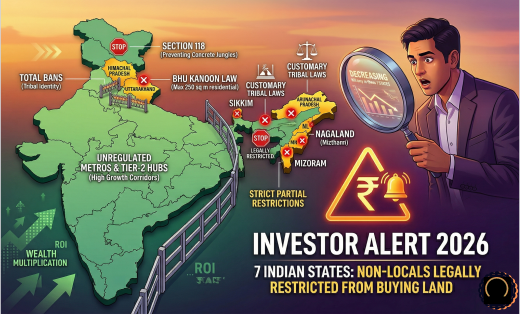
Investor Alert 2026: 7 Indian States Where Non-Locals Cannot Buy Property
Discover the 7 Indian states where non-locals are legally restricted from buying land in 2026. Protect your real estate investments with our expert legal guide.
Table of Contents
The Indian real estate market presents incredibly lucrative opportunities, but borderless investing comes with severe legal boundaries. For High-Net-Worth Individuals (HNIs) and second-home buyers looking to expand their property portfolios in 2026, understanding state-specific land laws is non-negotiable.
The Indian Constitution empowers specific states—often via Articles 371A through 371J—to strictly protect their indigenous identity, cultural heritage, and natural resources. In these regions, land is not treated as a tradable asset but as a vital community resource tied to survival and livelihood. Before you allocate your capital, here is the definitive 2026 legal guide to the seven Indian states where non-locals face total bans or extreme restrictions on buying property.
1. Arunachal Pradesh: Customary Tribal Laws
Restriction Level: Total Ban
The Law: Land ownership in Arunachal Pradesh is strictly governed by customary tribal laws. Non-tribals, including fellow Indian citizens from the plains, cannot own landed assets. Even entering the state requires an Inner Line Permit (ILP), heavily emphasizing that outsiders are guests, not settlers.
Restriction Level: Total Ban
The Law: Under Article 371A of the Constitution, the Naga people retain absolute authority over their land and its resources. The real estate market is completely closed to outsiders, and land transfers are strictly community and tribal-driven.
2. Nagaland: Absolute Community Ownership
Restriction Level: Total Ban
The Law: Similar to Nagaland, Article 371G protects Mizo land. Recent 2025 legal reviews reaffirm that land ownership is a constitutionally protected right of the indigenous tribes, ensuring non-Mizos are entirely legally restricted from acquiring property in the state.
3. Mizoram: Tight Indigenous Regulation
Restriction Level: Total Ban
The Law: Sikkim's protection under Article 371F is unique. Despite integrating with India in 1975, it retained its old land laws. Only individuals officially recognized as “Sikkimese” can own land. Real estate investors from the rest of India find it impossible to buy outright and must usually settle for long-term leases instead.
4. Sikkim: The "Sikkimese" Exclusivity
Restriction Level: Total Ban
The Law: Following a sweeping 2025 Land Notification, the government strictly prohibited the registration of land transfer deeds from indigenous persons to non-indigenous outsiders. This policy has effectively locked external investors out of the local real estate market.
5. Manipur: The 2025 "Indigenous First" Policy
Restriction Level: Strict Partial Restriction
The Law: Under Section 118 of the Tenancy Act, you cannot buy agricultural land unless you are an established local farmer. The primary goal is "Earth Value"—preventing concrete jungles from destroying natural growth. However, non-residents can purchase pre-constructed flats in urban areas or seek special government permission to buy small residential plots (usually capped at 500 sq. meters).
6. Himachal Pradesh: The Section 118 Hurdle
Restriction Level: Strict Partial Restriction
The Law: The heavily debated 2025 Bhu Kanoon (Land Law) has imposed a blanket ban on outsiders buying agricultural or horticultural land across 11 hilly districts. To prevent demographic shifts and protect indigenous populations, non-residents are now strictly limited to a one-time purchase of a maximum of 250 sq. meters for residential use only.
7. Uttarakhand: The 2025 Bhu Kanoon Law
For investors looking to align with the "smart money" in 2026, navigating these legally restricted zones requires extreme caution. Instead of forcing capital into legally hostile markets, industry data suggests a massive shift of NRI and HNI investments toward unregulated, high-growth corridors in major metropolitan and tier-2 hubs. Always consult local legal experts before transferring funds to ensure your capital doesn't get trapped in voided land deeds.
The Bottom Line for Smart Investors
To deepen your understanding of Delhi-NCR’s real estate trends and premium markets, explore these TFRG insights:
Delayed Home Loan Disbursement 2026: How Builder Delays Impact Your EMI & Pre-EMI Interest
Delhi Rent Control Act 2026: How Outdated Laws Are Crushing Landlord ROI & Rental Yields
Naugaon Real Estate Boom 2026: NCR’s 90-Minute Getaway Driving Massive Property ROI
Home Loan Tax Benefits 2026: The Ultimate Guide to Claiming Stamp Duty & EMI Deductions
Top Clubhouses in Delhi 2026: How Elite Amenities Drive Luxury Real Estate ROI
Related Reads to Explore
Explore Other Prime Real Estate Opportunities in NCR
There are several verified and ready-to-move flats available in the region. At The Fortune Realty Group, we provide expert guidance and curated listings to help you find the perfect property.
You can explore:
Flats in Chattarpur & Vasant Kunj – Affordable options with excellent metro connectivity.
Farmland in Manesar – Ideal for investment and weekend retreats.
At The Fortune Realty Group, we help you find:
✅ Verified luxury builder floors with clear registry
✅ Prime locations like Gurugram, Manesar, Chattarpur, Vasant Kunj, Vasant Vihar, and more emerging hotspots
✅ Full support with home loans, legal formalities, and after-sales services
✅ Zero brokerage deals — so your investment goes directly into your dream home, not middlemen
With booming infrastructure, excellent connectivity, and rising demand, Gurugram, Manesar, Chattarpur, Vasant Kunj, and Vasant Vihar have become top choices in Delhi NCR for luxury living and high-return real estate investments.


Verified luxury builder floors with clear registry
How TFRG Makes Luxury Buying Stress-Free

Looking to Invest in South Delhi or Manesar?
Contact TFRG today for verified listings, legal due diligence, and best-in-class guidance across residential, commercial, and plotted developments.
The Fortune Realty Group
Experience hassle-free property deals with zero brokerage.
Contact Us
Inquiry
support@thefortunerealtygroup.com
+91-9990990317
© 2025. All rights reserved. Designed by PC Media House.